

If you’re used to landing in a European city, opening an app, and grabbing a car by the minute — reset that expectation before your plane touches down in Antalya.
Carsharing in Turkey barely exists, and where it does exist, it was never built for you.
Turkey got its first carsharing company back in 2012, in Istanbul. The sector never grew from there. An academic study of the Turkish market found that of four carsharing companies operating in the country, two shut down over time — and the researchers’ own conclusion was blunt: the model turned out to be a poor fit for the Turkish market. The same study found that while 69.5% of surveyed locals had heard of carsharing, 87.7% had never actually used it.
What survives today is concentrated in Istanbul, Ankara, and Izmir — services like TikTak rent cars by the minute, but strictly inside defined service zones in those cities. Resort regions never got the model at all: as of late 2025, there was no full per-minute carsharing in Bodrum, and Antalya is in the same position.
Even in Istanbul, where the services do operate, a tourist hits the wall at registration — before ever seeing a car. The requirements stack up fast:
On top of that, most local apps work only in Turkish, and support doesn’t speak English or Russian. One traveler who tried to find working carsharing in Turkey in 2026 summarized it plainly: it’s a functional tool for locals and expats, and a dead end for visitors — “either a quest of getting a local SIM and cards, or just forget it.”
There’s one more trap worth naming: the per-minute tariff doesn’t stop in traffic. In a city with Istanbul-level congestion, the meter keeps running while you stand still on the Bosphorus bridge.
The realistic options narrow down to three: taxi, public transport, and your own feet. Each covers its niche, and each has a hole in it.
Taxis in Antalya are cheap by Western standards, but “cheap per ride” stops being cheap when you’re doing it three or four times a day, every day of a two-week stay. Buses and the tram work, but a trip that takes 15–20 minutes direct routinely stretches to 30–60 minutes once you add waiting, transfers, and detours through residential blocks. Walking is free and pleasant — within about a kilometer and a half, in 34-degree heat, less so.
What’s missing is exactly the thing carsharing was supposed to be: on-demand transport for the middle distance. The 2–8 km trip. Too far to walk, too short to justify a taxi twice a day, too awkward for a bus schedule.
This is where a scooter fits — not as a replacement for a car, but as the missing layer between the options that exist.
Think of it as a guide between two extremes. Taxi is the ceiling: comfortable, door-to-door, priced per ride. Walking is the floor: free, slow, limited by heat and distance. A scooter sits in between and covers the gap both leave open — the beach that’s 4 km away, dinner across town, the viewpoint you’d skip if it meant two buses.
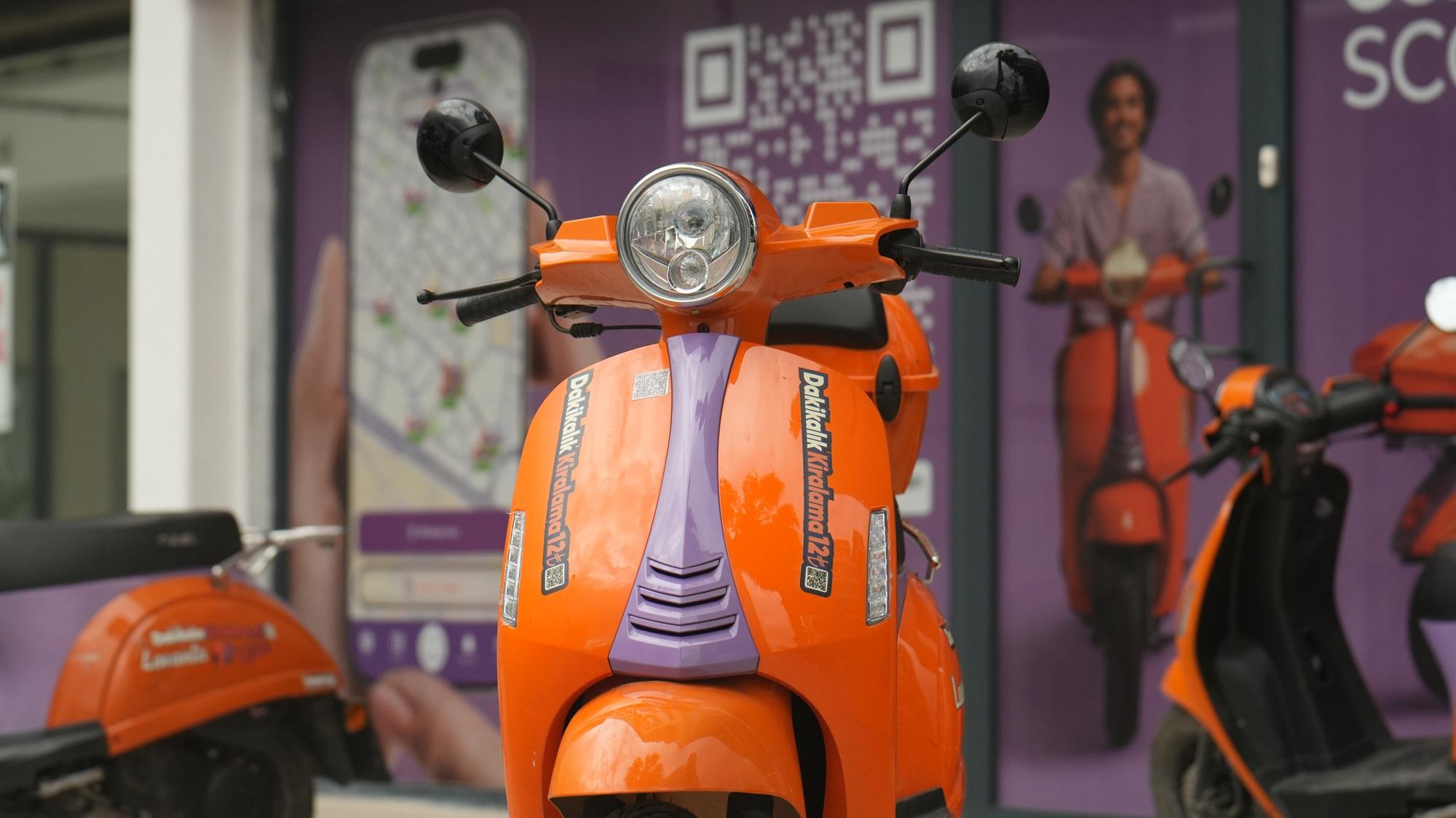
The mechanics match how tourists actually move. You pay per minute only while riding — 12₺ per minute, no deposits, no fixed daily cost. Registration asks for what you already have: a passport, your regular Category B driving license, and a selfie — no Turkish phone number, no local bank card, no e-Devlet account. Payment works with international Visa and Mastercard, Turkish cards, and other systems, so foreign cards aren’t a barrier. And the service zone is built around where tourists actually go — the beaches, the old town, the coastal road — not around administrative districts.
Unlike a carsharing car, a scooter doesn’t charge you for standing in a traffic jam: it goes around the jam. And unlike a taxi, it’s there on the map near you, without a call, a wait, or a conversation.
Carsharing in Turkey never grew past a local tool for locals — two of four companies folded, the survivors require Turkish phone numbers, Turkish bank cards, and staying inside tight city zones, and resort regions like Antalya and Bodrum never got the service at all. What’s left for a tourist is a choice between paying per taxi ride, losing an hour to a bus route, or walking in the heat. A scooter doesn’t replace any of them — it fills the space between them, which is where most of your actual trips in Antalya happen.