

Moving to another country rarely starts with paperwork alone. More often, it comes down to two questions at once: where you will live and what you will rely on financially in the new country.
For many entrepreneurs and families who see Turkey as their future home, a business becomes not only a source of income, but also part of their legalization strategy.
In this context, not just any business is interesting, but one that can be built into real everyday life in Turkey: with a clear model, transparent operations and the ability to lean on local infrastructure. That is why franchise formats in service niches are increasingly seen not only as an investment, but also as a practical way to combine relocation with launching your own business.
Why business is often considered together with a residence permit
For a foreigner, Turkey is a country where questions of residence, work and legal status are closely linked. Owning a company by itself can be a basis for legal presence, but it does not automatically give the right to work: if the owner actually manages the company, signs documents and runs day‑to‑day operations, a work permit is required for that.
This is why, when planning a move, it is important to see the business not as “paperwork for the file”, but as a living structure. Turkish authorities look not only at company registration, but also at real activity, capital, employees, address, accounting and compliance with set criteria. The clearer and more grounded the business model is, the easier it is to build long‑term legalization without feeling that everything rests only on a paper scheme.
Why a franchise can be easier than starting from scratch
Opening a business from scratch in a new country is always harder than it looks from the outside. Even experienced entrepreneurs usually struggle not with the idea itself, but with local operations: registering a legal entity, setting up accounting, finding contractors, dealing with licences, hiring staff, signing the first contracts and handling daily details that never show up in pitch decks.
In this sense, a franchise looks like a more stable format, especially for those who are simultaneously solving practical relocation issues. Instead of assembling the model from zero, testing demand and building a brand alone, an entrepreneur gets an existing system: a clear product, a working service logic, a brand, a technological base and a team that understands the Turkish market from the inside.
This does not remove the owner’s responsibility and does not turn the business into a “passive residence permit”. But it reduces the number of unknowns at the start – and for a new country, that is one of the most valuable factors.
How Lavanta Ride fits this logic
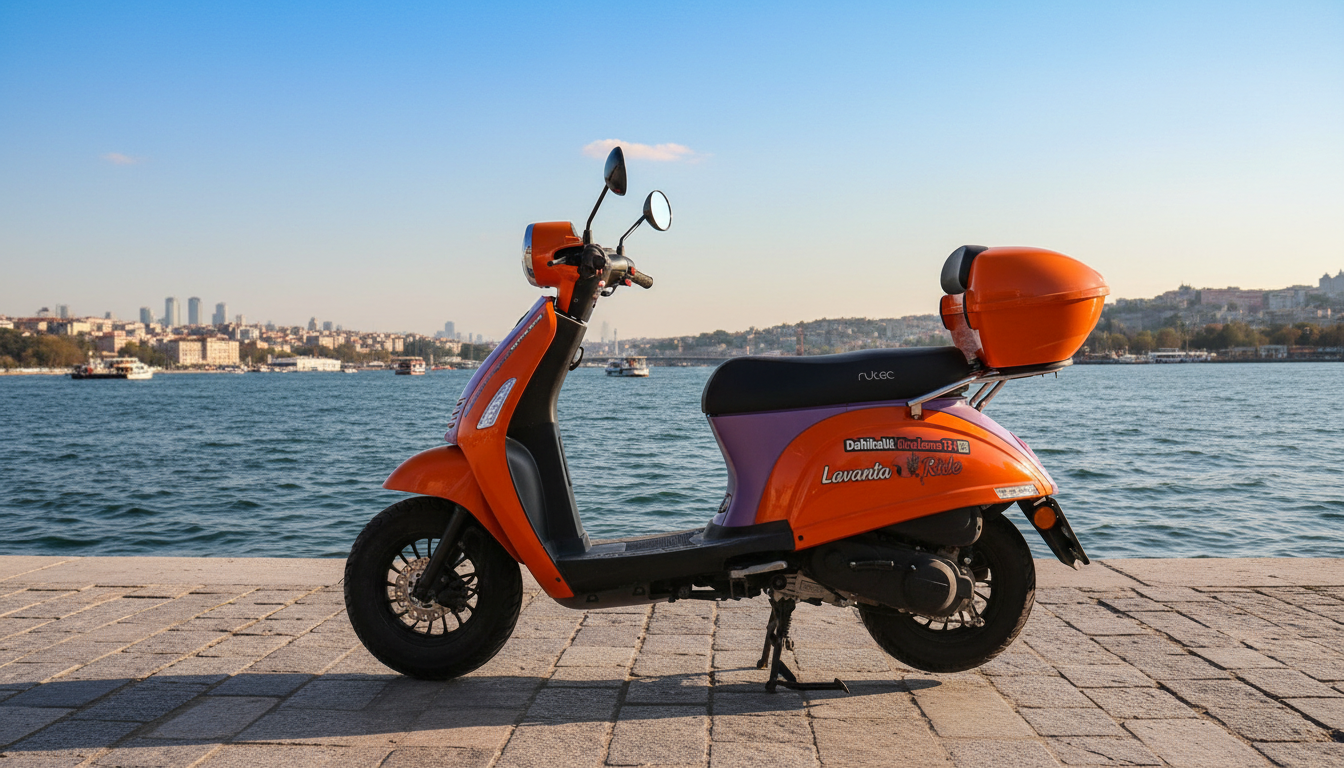
Lavanta Ride is a gasoline scooter rental service launched in Turkey as an urban mobility model with its own infrastructure and app. The project is developing as a practical service for cities with high tourist and local traffic, where people need fast everyday transport, not just a seasonal attraction.
For someone considering a move to Turkey, the important thing here is not only the product itself, but the nature of the business. A mobility service is not an abstract “company on paper”, but an operational model with vehicles, locations, maintenance, a flow of customers and a clear revenue logic. This kind of format is easier to perceive as a real business around which you can build both your life and your status in the country.
An additional factor is that the structure is already assembled. The Lavanta Ride franchise assumes you can lean on an existing model, brand and technology stack instead of inventing everything yourself in an unfamiliar environment.
Why this can be attractive for those looking for “2‑in‑1”
For many families and solo entrepreneurs, moving to Turkey is not only about climate or geography. It is an attempt to build a more resilient way of life: living in a country they understand, having a solid base in the form of their own business and not relying entirely on remote income or an uncertain status.
In this context, a franchise can be seen as a “2‑in‑1” format:
This is especially relevant for people who are not looking for a large‑scale investment project at the first stage. Sometimes the task is different: to create a foothold in the new country, understand the environment, integrate into the market and have a business that exists not only on paper.
What is important to understand in advance
Despite the appeal of this model, it is crucial not to mix different legal foundations. Having a business does not automatically mean you can work without a separate permit, and having a franchise does not exempt you from requirements related to the company, accounting, taxes, address and staffing.
If a foreign owner plans to be actively involved in management, they need to think in advance about the combination of company form, capital, possible headcount, grounds for a work permit and residence status. In Turkey, these questions are better designed up front, not “fixed later” after registration, because that is exactly when extra costs and unnecessary delays usually appear.
So in this scenario, it makes sense to see a franchise not as a shortcut, but as a more organized route. It does not cancel the rules of the country, but it can make both market entry and the adaptation process more understandable.
Who this format works best for
Most often, this path is interesting for those who:
In this sense, the Lavanta Ride franchise is not just a story about transport. It is one of the examples of how doing business in Turkey can become part of a broader task: moving, adapting and building a new point of support in the country.
The information on this site does not constitute legal advice and is provided for general informational purposes only. For current information tailored to your personal situation, we recommend consulting a qualified professional.