

Yes — for most of the city, most of the time.
Whether it makes sense for you depends on where you live and what you’re comparing it against.
Antalya’s public transport isn’t bad by regional standards. The tram runs from the airport to the city center and Konyaaltı Beach roughly every 10 minutes, and single fares run 3.2–15 TL depending on payment method — cheapest with an AntalyaKart, most expensive on contactless card. Buses cover most of the city, and dolmuş minibuses fill in the routes trams and buses don’t reach. Transfers between modes are free within an hour if you’re using the card.
Taxis are genuinely cheap by Western standards — a 3 km ride runs roughly $1–2, and even the airport transfer costs 300–500 TL by taxi or 80–100 TL by Havaş bus.
On paper, that sounds like enough. In practice, it depends entirely on your neighborhood.
Konyaaltı and the historic Kaleiçi area are the two zones where going carless is realistic without much compromise. Both are walkable, both sit on the tram line, and daily essentials — groceries, cafés, the beach — are within a short walk. Residents there report going weeks without renting a car at all, using one only for out-of-city trips.
Muratpaşa, closer to the center, works reasonably well too — less beachfront, more density, still tram-adjacent.
Kepez, the more residential and budget-friendly district, is a different story. Multiple neighborhood guides flag it explicitly as “not suitable for those without a car.” Lara has similar issues outside its immediate beach strip — spread-out, resort-style layout that public transport wasn’t really designed for.
This is the real answer to “can you live in Antalya without a car”: yes, if you chose your neighborhood with that in mind. If you didn’t, you’re stuck waiting for infrequent buses or paying for taxis on repeat, which quietly adds up.
Before assuming a car solves everything, the numbers are worth knowing. Annual road tax (MTV) alone runs from around 2,500 TL for an older small car up to 15,000 TL for a newer large one. Mandatory traffic insurance adds another 3,000–10,000 TL a year, and comprehensive kasko coverage — genuinely worth having — costs another 6,000–20,000 TL. Inspection runs 1,100 TL for cars. Parking in urban areas is 20–60 TL per hour if you’re not lucky enough to have a free spot.
None of this is dramatic on its own. Stacked together, it’s a fixed monthly cost that exists whether you drive the car once or every day.
Here’s the part that doesn’t show up in cost breakdowns: waiting.
Buses in Antalya aren’t frequent everywhere, and a trip that should take 15 minutes by direct route often takes 30–60 by bus once you factor in waiting, transfers, and detours through residential blocks. Taxis solve the time problem but not cheaply if you’re doing it multiple times a day, every day.
This is the actual gap in Antalya’s transport picture: not the first-mile or last-mile problem cities usually talk about, but the middle distance — 2 to 8 km trips that are too far to walk, too short to justify a taxi every time, and too awkward for a bus schedule that doesn’t quite match your day.
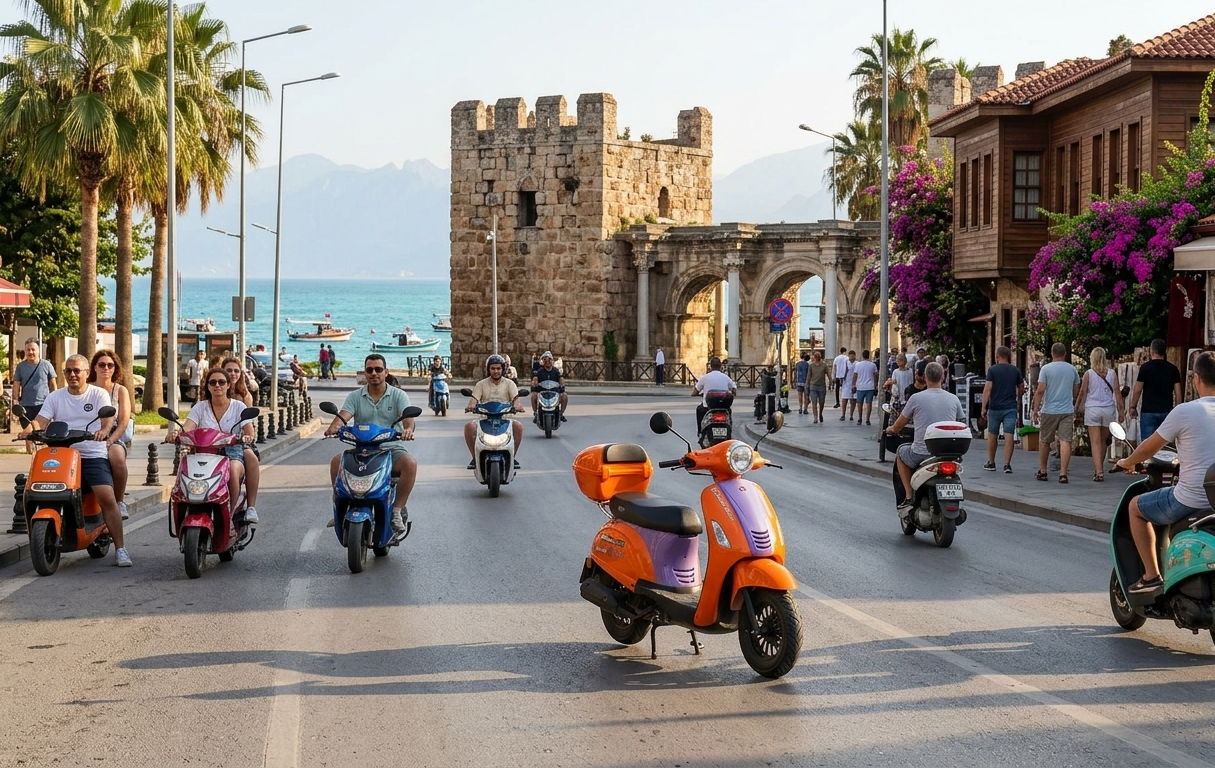
A scooter doesn’t replace public transport or a car. It replaces the specific trips where both options are inconvenient — the beach run that’s 4 km away, the errand across town that would eat an hour on a bus, the evening plan that starts after the bus schedule thins out.
There’s no fixed monthly cost, no insurance renewal, no parking search. You pay for the minutes you actually ride, park where you’re actually going, and skip both the waiting and the taxi math. For someone splitting their week between walkable Konyaaltı errands and the occasional trip to Lara or Muratpaşa, that flexibility often matters more than owning a full vehicle outright.
Living in Antalya without a car is realistic if you live in the right neighborhood and are willing to combine tools rather than rely on one. Walk what’s walkable, use the tram and buses for predictable routine trips, keep a taxi for late nights, and use a scooter for the in-between distances that public transport handles badly. That combination costs less than car ownership and, for most day-to-day life in this city, covers more ground than any single option on its own